The Anatomy of the 1-of-1 SKU: Why Traditional Retail Operations Fail in Recommerce (And How to Fix It)
For the past decade, retail leaders have been chasing the circular economy. The consumer demand is undeniable, the ESG benefits are clear, and the sheer volume of available secondhand goods is staggering.
But if you are a COO, VP, or Director operating at scale in the thrift or recommerce space—like Goodwill or other large regional operators—you know the dirty secret of secondhand retail: Acquiring inventory is easy. Processing it profitably is a logistical nightmare.
To understand how to unlock millions in hidden revenue on your retail floor, we first have to deconstruct why traditional retail operational models completely break down in a recommerce environment, and why the solution lies entirely in how you capture data.
The Fundamental Difference: SKU Depth vs. SKU Breadth
The traditional retail supply chain is built on SKU depth. A buyer negotiates with a vendor for 10,000 units of the exact same black t-shirt.
- It requires one barcode.
- It requires one pricing strategy.
- It requires one e-commerce listing with one set of photos.
Recommerce, on the other hand, is built on infinite SKU breadth. Your donation centers don't receive pallets of identical items; they receive 10,000 entirely unique, 1-of-1 items.
When you try to apply traditional, manual processing methods to 1-of-1 SKUs, you create a massive operational bottleneck. Having a human team manually inspect, identify, research, and price every single unique item destroys your labor efficiencies. It is a model that simply cannot scale.
The Hidden Cost of "Guesswork Pricing"
When your floor staff is faced with a mountain of un-sorted inventory, they are forced to make split-second decisions. Without standardized data, pricing becomes a guessing game. This leads to two critical failures that destroy your bottom line:
1. Margin Leakage on High-Value Items: A floor worker might not recognize the difference between a modern, mass-produced Nike sweatshirt and a highly sought-after vintage 90s Nike piece. The vintage item gets a generic $6.99 tag and is bought by a reseller who flips it for $150. You just lost margin that should have funded your mission.
2. Dead Stock and Stalled Sell-Through: Conversely, low-value fast-fashion items (like Shein or Zara) often get over-priced. They hit the retail floor and sit there for weeks. They take up valuable physical real estate, kill your sell-through rates, and ultimately end up in the salvage bin.
You cannot maximize Average Selling Price (ASP) or sell-through velocity when your pricing strategy relies on the gut feeling of the person holding the pricing gun.
The Digital Blindspot: Why Omni-Channel Fails in Thrift
The biggest buzzword in retail is "omni-channel"—the ability to seamlessly sell inventory both in-store and online. But how can you sell a 1-of-1 item online if you don't know it exists?
If a premium item is simply tagged "Mens Jacket - $14.99," it is digitally invisible. Without rich metadata—the specific brand, the exact size, the condition, the gender, the material—that item is trapped within the four walls of your physical store, limited to local foot traffic.
To unlock true omni-channel, you have to capture rich data at the exact moment of ingestion.
The Unlock Lays With the Data (The Hammoq Solution)
You cannot scale a $300 billion recommerce market with manual data entry. You scale it with data and automation.
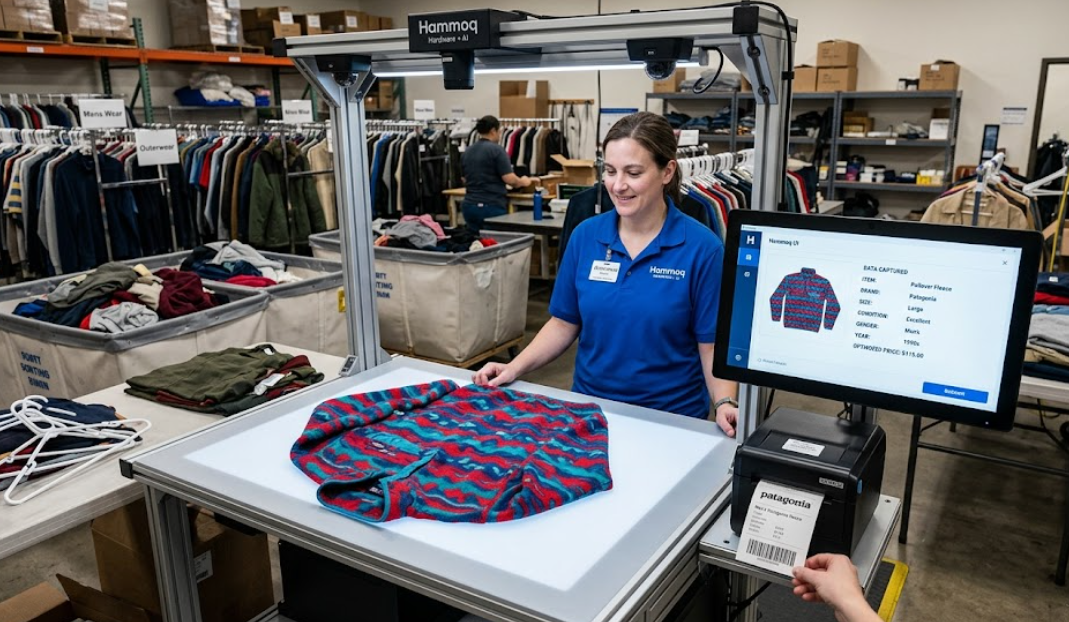
At Hammoq, we realized that software alone wasn't enough to solve the physical bottleneck of sorting clothes. We combine Hardware + AI to automate the most labor-intensive part of your business: ingestion and pricing.
We didn't just build this overnight. We started in e-commerce 5 years ago, methodically building the world’s largest database of used items. We use this massive proprietary dataset to train our AI on what matters most.
Here is how deploying a Hammoq rig in your processing center or retail backroom transforms your operations:
- Instant, Rich Data Capture: Place an item under the Hammoq hardware, and our AI vision instantly identifies it. In seconds, we capture all the data your team wishes they had time to record: Department, Item, BRAND, Size, Condition, Gender, and much more.
- Dynamic, Data-Driven Pricing: No more guesswork. Our system analyzes millions of historical and real-time data points to tell you exactly what an item is, where it belongs (in-store vs. online), and how much it should actually sell for to maximize your top-line revenue.
- Seamless POS Integration: We close the operational loop. Once the AI identifies and prices the item, we generate the retail tag automatically, directly inside of your existing POS system.
Bridging the Gap
By digitizing your inventory the second it enters your building, you gain total control over your margins. You can automatically route high-value items to your e-commerce channels (like ShopGoodwill) with pre-filled, SEO-rich listings, while ensuring your physical retail floor is stocked with perfectly priced goods that turn over quickly.
You optimize efficiencies, you eliminate human guesswork, and you reclaim the millions of dollars currently being left on your retail floor.
See The Data in Action
We know that overhauling your unique workflow requires trust and proof. If you want to learn more about the operational efficiencies and revenue you may be missing out on, the next step is simple.
Take a complimentary demo with our team. We will show you our Hardware + AI solution processing real items in real-time. Then, we let you decide if the data makes sense to try out on a low-risk, 3-store pilot.
Stop guessing. Start capturing. Reach out today to see the Hammoq difference.


