
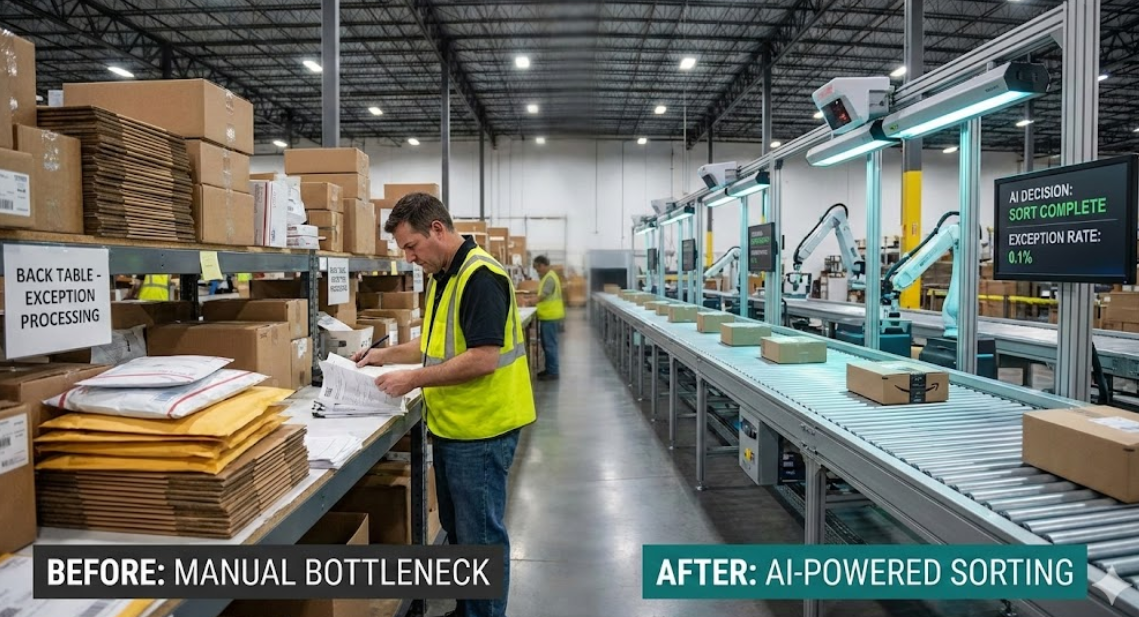
The Death of the Back Table: How AI Removes Manual Decision Bottlenecks After Sorting
TL;DR Summary
Sorting hardware modernized throughput for Goodwill. But manual decision-making after the line still creates revenue leakage. Hammoq eliminates the back-table bottleneck by automating identification, pricing, and routing at intake.
Longer Description
Over the last decade, Goodwill organizations have made meaningful investments in sorting hardware to increase processing speed, improve safety, and standardize intake. Conveyors, automated distribution bins, and mechanical sorting systems have dramatically improved throughput.
But while physical movement has accelerated, decision-making has not.
After items leave the sorting line, many still sit on what operators commonly call “the back table.” This is where staff must:
- Identify the item manually
- Research comparable pricing
- Decide whether it belongs in-store or online
- Determine an appropriate price
- Apply tags and route inventory
This stage is labor-intensive, inconsistent, and slow relative to the speed of hardware. More importantly, it is where value quietly erodes.
A conservative pricing decision reduces ASP.
An aggressive pricing decision reduces sell-through.
A missed eCommerce opportunity caps revenue potential.
Multiply that across thousands of items per day, across dozens of locations, and the financial impact compounds.
Hammoq integrates directly alongside our exclusive hardware partner to eliminate this bottleneck entirely.
At intake, AI:
- Identifies brand and category instantly
- Analyzes 30 / 90 / 365-day POS sales windows
- Determines the highest-performing sales channel
- Calculates pricing aligned to both ASP and sell-through objectives
- Prints retail tags immediately or routes items directly to eCommerce workflows
The result is a closed-loop intake system.
The conveyor no longer feeds a back table.
It feeds a decision engine.
Key Takeaways
- The true bottleneck in modern Goodwill operations is post-sort decision-making
- Manual pricing introduces inconsistency and margin risk
- AI removes secondary handling and protects revenue at scale
What’s Next (How To)
- Measure average time between intake and final pricing decision.
- Identify how many items require secondary handling after sorting.
- Evaluate intake-based AI decision automation to eliminate back-table workflows.


