
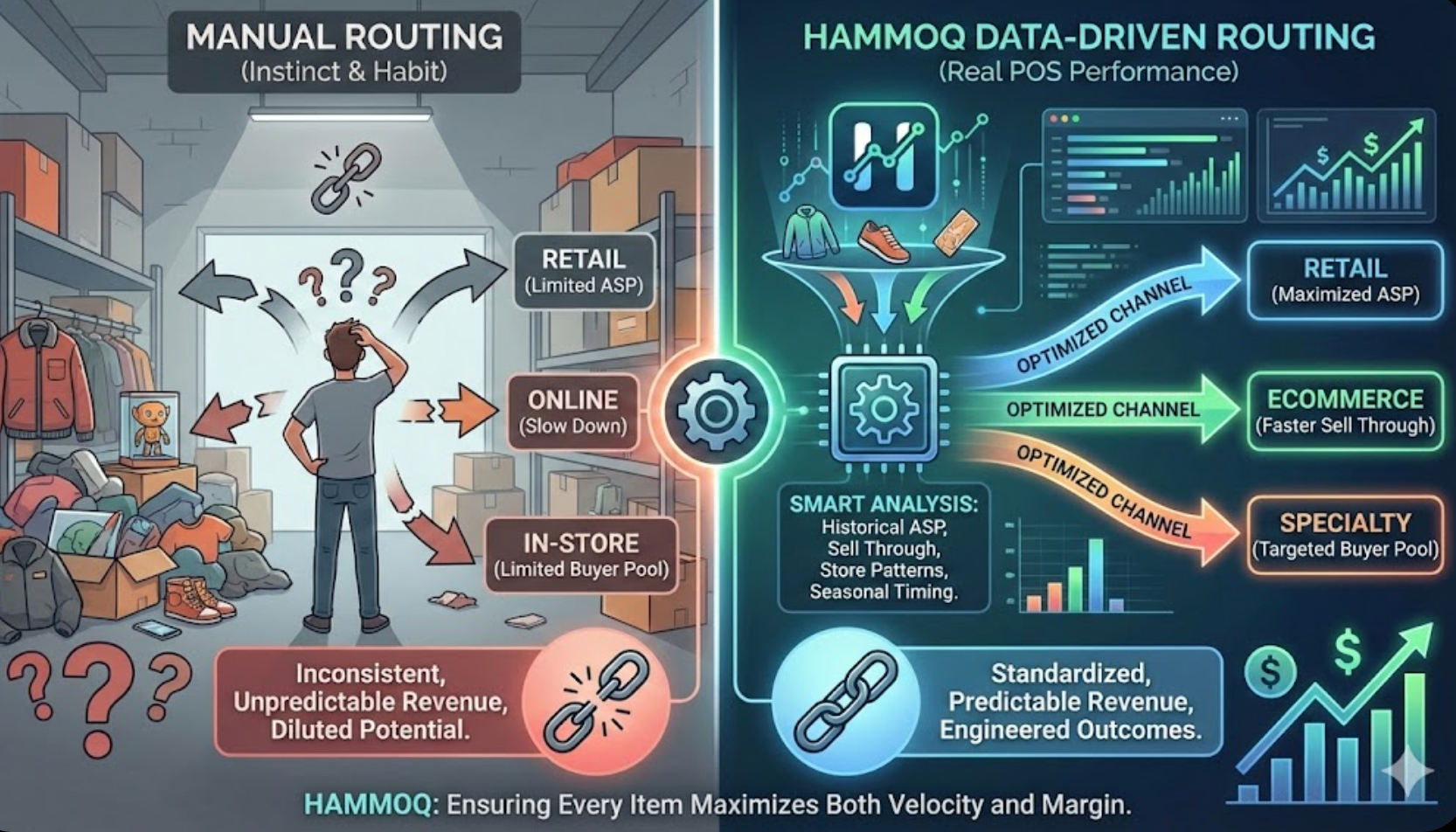
Hammoq ensures every item is routed to the channel that maximizes both velocity and margin using real POS performance data, not instinct.
Routing Is Quietly Costing You More Than You Think
Most resale leaders focus on pricing.
Far fewer focus on routing.
But where an item goes often determines more financial impact than the number on the tag.
A premium jacket routed to retail when online demand is stronger caps its ASP.
A collectible left in-store limits its buyer pool.
A high-velocity retail item sent online may slow down unnecessarily.
Routing directly affects:
- Average Sale Price (ASP)
- Sell Through rate
- Inventory turn speed
- Margin consistency
And yet, in many organizations, routing decisions are still based on habit, local preference, or individual experience.
That variability compounds across stores.
The Problem With Manual Allocation
Manual routing cannot consistently account for:
- Channel-specific Sell Through differences
- Store-level performance variation
- Regional demand shifts
- 30, 90, and 365+ day performance trends
What performs best in one region may underperform in another.
What worked last quarter may not work this month.
When routing is inconsistent:
- ASP fluctuates unnecessarily
- Channel mix drifts
- Inventory velocity becomes unpredictable
- Revenue potential is diluted before pricing even matters
How Hammoq Makes Routing a Financial System
Hammoq evaluates every item at intake against real POS data.
Instead of asking staff to decide where something “feels right,” the system analyzes:
- Historical ASP by channelf
- Sell Through velocity
- Store-level performance patterns
- Seasonal timing
Then routes the item — retail, eCommerce, or specialty — based on performance, not preference.
Routing becomes standardized across stores. Allocation becomes measurable. Channel strategy becomes intentional.
This is not about pushing everything online.
It’s about ensuring every item is placed where it performs best.
From Inconsistent Allocation to Predictable Revenue
When routing decisions are automated:
- Channel mix stabilizes
- ASP improves systematically
- Sell Through becomes more predictable
- Leadership gains clearer visibility into performance drivers
Revenue becomes engineered, not incidental.
Key Takeaways
Routing directly impacts margin and velocity. Manual allocation introduces variability. Data-driven routing standardizes revenue outcomes.


